
A couple of hours on a plane and there we were, an entirely new continent! Africa! For two months! I didn’t know how to feel about this yet. Was it excitement? Apprehension? Fear? Probably all three if I’m honest. It took a while for us to get through customs, and by the time we did our taxi driver (who was supposed to wait for us) had given up and left. We called the riad (a traditional house built around a courtyard, which are often turned into hotels) and they said the taxi would be back soon. It seems that soon in Morocco means about an hour.
It was immediately apparent that we were on another continent. The streets were like nothing we’d ever seen before, like something out of the set of Aladdin. These huge 12th century stone walls (19km of them) encircled the city, like a maze. I was starting to feel a bit claustrophobic if I’m honest. I wonder if Pacman ever feels that way. We had to get out and walk the last part of the journey on foot as the taxi couldn’t get through the crowds and the narrow streets, and then we had finally arrived.

We met Sam, the friendly owner of the riad. We would soon become good friends with him. We filled out paperwork then tried Moroccan mint tea for the first time. It was hugely popular there; a staple of any household/ shop/ restaurant. It’s hard to avoid really. After many questions (Dad was meticulous) we went to our room and after a long day of travelling we were not able to relax. Yes, you read that correctly. My parents were concerned the room smelled like damp and mould, so they went to ask our new friend if we could switch rooms. He graciously let us, and this room was in fact much nicer, and it was worth the swap.

I learned much about myself during my time in Morocco. Number one, I was deluding myself to think I was an adventurous traveler. Quite the opposite in fact. I am a timid traveller, I admit it now. I was a little bit scared to leave the riad. Also fortunately for me I was still sick, so I didn’t leave my room for about a day, maybe a little longer. I was very much enjoying having food delivered to me like some sort of sultan (keeping with the Aladdin references), but alas I couldn’t keep this up for long. It was time to rip the bandaid off.
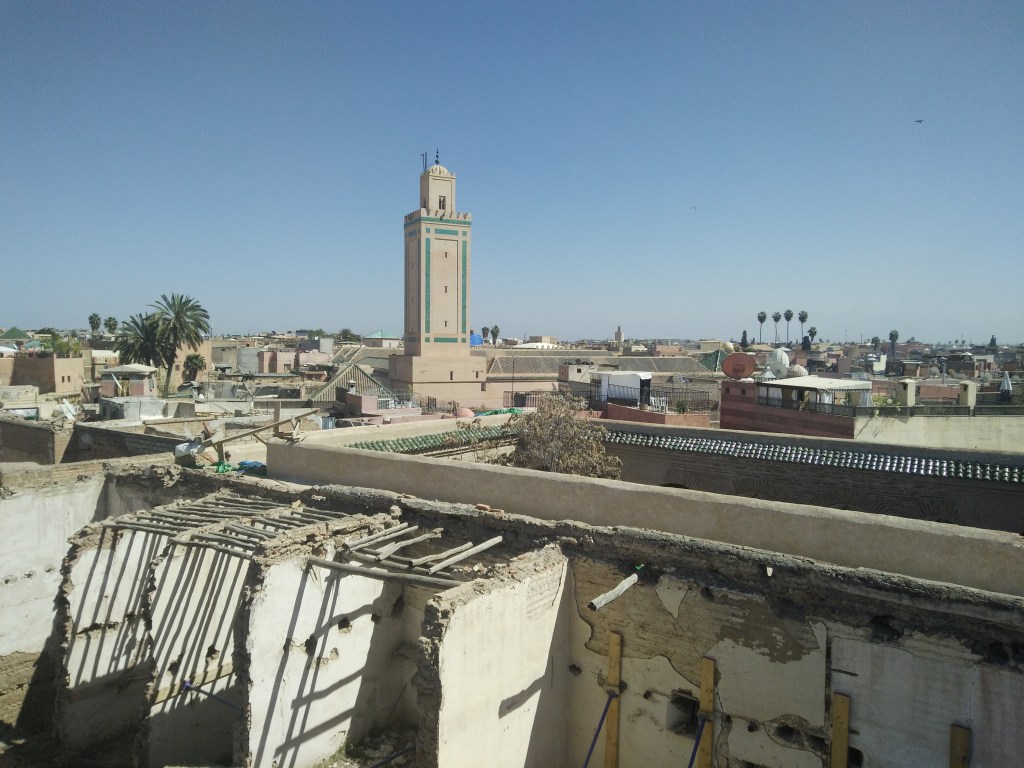
The streets were crowded, chaotic and confusing; a perfect mixture for those of us who like some sense of control of their surroundings. Market stalls lined the narrow, dusty streets, with sellers shouting at us continuously as we walked past. Sam had told us simply to say, “No thank you, I tried it yesterday, it was great,” whenever anyone offered us anything, which could be tweaked to fit the occasion. Although with our skin we stood out like a sore (very white) thumb, and we were hounded so constantly we had no choice but to ignore people. I learned to be very careful about where I looked, and not to show any interest in products, as the moment you asked any questions the seller would persist until you bought something, and chase you down the street if you respectfully declined (this happened twice before we learned our lesson).
Of course we got so used to ignoring people that this worked against us a few times. The first being that a man was shouting at us, and we assumed he was just another guy trying to sell us something so we ignored him. However it turned out that my mum had dropped her hat and he was actually trying to be nice and give it back, so we felt quite bad after. Then another time Dad got yelled at by someone who had obviously had enough of tourists ignoring him that day, and he kept saying, “You think you’re so much better than me!” Which was also unpleasant in a much different way. So how to correctly handle being harassed in the souks I still don’t know.

If we thought the streets were chaotic, the main square was something else entirely. Very early in our stay Mum and I went out to explore by ourselves. We were told it would be safe, as there are plain-clothed police everywhere, and it is a very popular tourist spot. However as I was walking along I had a book of henna designs thrust into my hands. To not be rude and so that they would accept it back I flicked through a few designs, before handing it back and saying what Sam had said, “Thank you, maybe tomorrow.” As I tried to leave the lady grabbed my hand in an iron grip, and thrust a syringe towards it. It was one of those moments where your mind goes a million miles an hour in panic thinking, “What is going on? Is she trying to inject me with something? Is she trying to knock me out to sell me to the slave trade?” My body remained absolutely still in shock, processing what was happening. Out of the syringe poured a brown liquid, and she began drawing a design on me (a crappy design, but lightning fast). I tried pulling away, and my mum was shouting, “Pull your hand away,” however she was not letting go. I eventually managed to yank my hand away, but it was too late. She was requesting payment for the flower a 2 year-old could have drawn (and I would have paid NOT to have on my body). We tried walking away but she started chasing us down the street, refusing to leave us alone shouting, “Pay me for my work, I have a baby!” We eventually gave her some money (not the ridiculous 20 euros she was asking) and she reluctantly let us be.

After this I was a bit traumatised, not to mention pissed off. Not only was it not real henna and was making my hand itch (most likely it was hair dye), I can actually do henna myself, and could have done a much nicer design. And now I was stuck with this sad excuse for a scribble on my hand for the next few weeks. We researched all the scams (don’t accept directions from anyone, agree to be taken to a tannery or accept tea at a carpet shop) and decided it was best if we didn’t leave the riad without dad from now on. It made me angry as a feminist, but safety is far more important than pride.
That night we decided to eat at the riad rather than venture into the medina (the old walled part). We shared a tajine (a meal we would become very familiar with over the coming months) and had a nice chat to Sam as well. It often happened this way that we would go up to sit on the comfy chairs on the roof (it’s very common for Moroccan houses to have a terrace) and we would talk to him and other guests. We learned a great deal about the Moroccan mindset, as well as Sam personally.

He was born in a small village in the Atlas Mountains, and dreams of one day owning a big hotel. He also speaks about 6 languages (Arabic of course, French which is commonly spoken as well, English, Spanish, Italian and he’s learning German) which we were very impressed by. We got a sense of the Moroccan view of the world, although Sam’s views had clearly shifted after speaking with many tourists. Although he grew up as a devout Muslim, he is now a man of science and reads widely. We got the sense that Moroccans generally aren’t as open-minded as he was about many political topics, and he was eager to speak openly and discuss more contentious issues. He was shocked to learn that other countries allowed women in the military (he wasn’t a feminist quite yet). He was also a terrible cheat at Jenga, and would catch the tower and prop it back up if he knocked it down.
The breakfasts he provided in the morning were also quite lovely, and the waiter very friendly. We were impressed at the range of foods they were able to make with such a limited kitchen (a benchtop gas cooker), such as these pancake type things, baguettes and flat breads with butter, jam honey and nut spread (almond and argan oil), the occasional baked good, a few times these Moroccan style doughnuts, orange juice and (of course) mint tea.
After the incident with the mean henna ladies I decided it was best to venture out again into the medina and walk around the souks (markets) as it’s best not to avoid things, and also Mum made me. There are some lovely things on sale that I would have loved to buy if I had enough room in my suitcase, such as the leather goods, metal plates, chandeliers and tea sets. Other items sold are clothes, food (sweets and takeaway savoury items), jewellery and more nick nacks. In the big square there are also snake charmers, people with monkeys and the dreaded henna ladies, but it’s best to stay away from those guys.

After this successful outing we decided to go further afield outside of the medina with a trip to the Majorelle Gardens and the Yves Saint Laurent Museum (which are next to each other). The gardens were lovely, although the sun made things difficult as we had to stand in line for a while, and walking around the gardens it was difficult to take photos. However perhaps it’s best sometimes to just enjoy things while you’re there. The Cubist buildings and structures in the garden were beautifully designed by French artist Jacques Majorelle, and painted in a royal blue. Inside one of them there was also a museum about the Berbers, which are the people who lived/live deep in the Atlas Mountains. Around 75% of Moroccans have Berber ancestry, and between 33 and 50% define themselves as Berbers. Outside, the gardens were very well maintained and different from anything I’d seen before. The dirt was kept bare (no mulch) and there were many heat loving plants, such as cacti, and succulents.
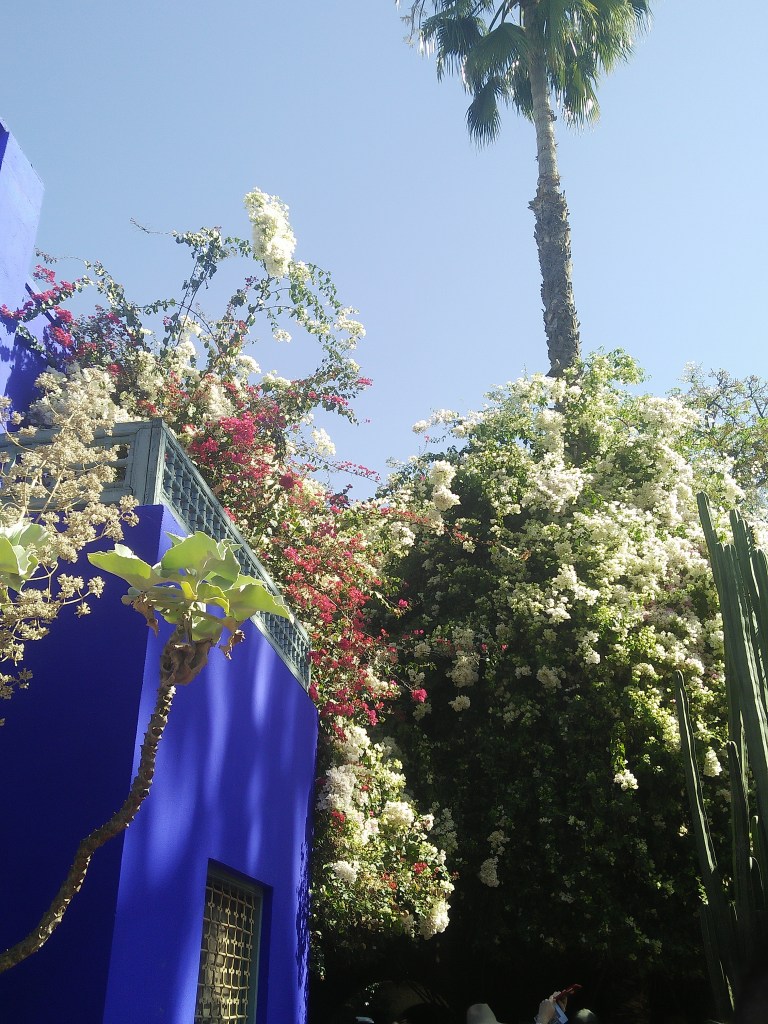
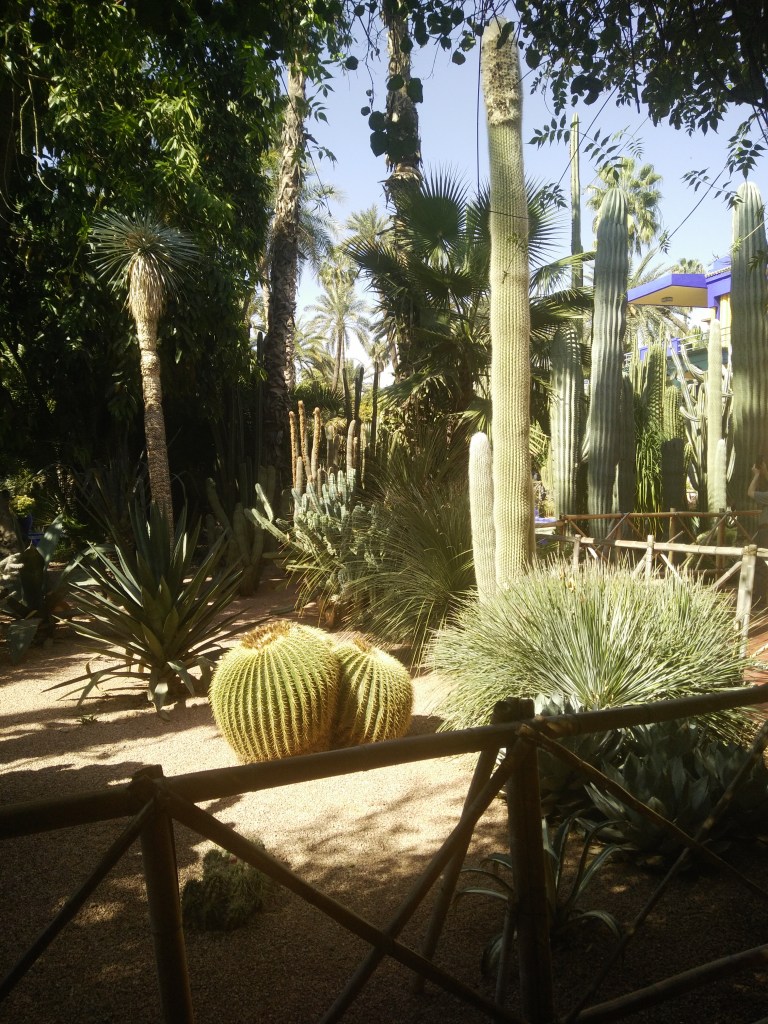

The Yves Saint Laurent Museum next door was also worth the visit. I knew next to nothing about the designer, aside from recognising the brand name, and enjoyed learning about his life, as well as looking at many of the breathtaking garments he designed. Unfortunately you can’t take photos inside the gallery, but of course you could always google his work.

Next was the House of Photography, one of the less interesting destinations, although still worth doing if you have time to kill. It was essentially a riad with a collection of black and white images (some of them very old) depicting the daily lives of the everyday Moroccan.
Other destinations within Marrakech were Saadien’s Tombs and El Badii Palace, although both were a little disappointing. At both you paid quite a lot to see relatively little. At the tombs we had to wait in line half an hour in the sun to get a 30 second glimpse inside before a man hurried us along. Then at the Badii Palace it was super overcrowded, and not in as good condition as the museum we had seen the day before.
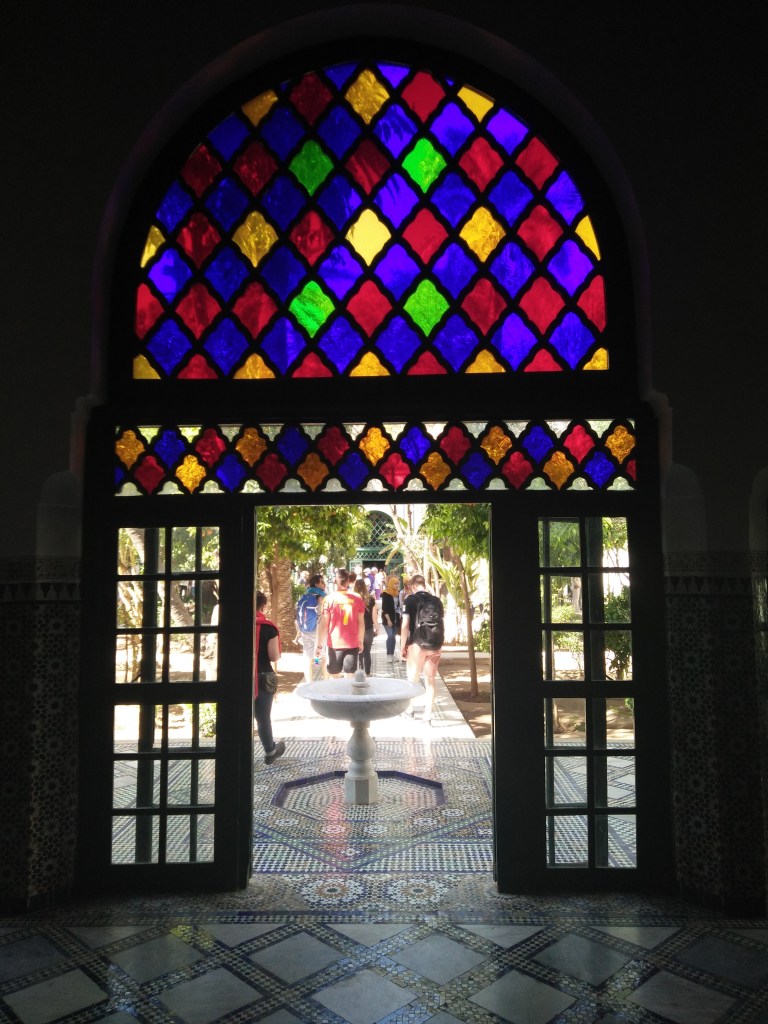
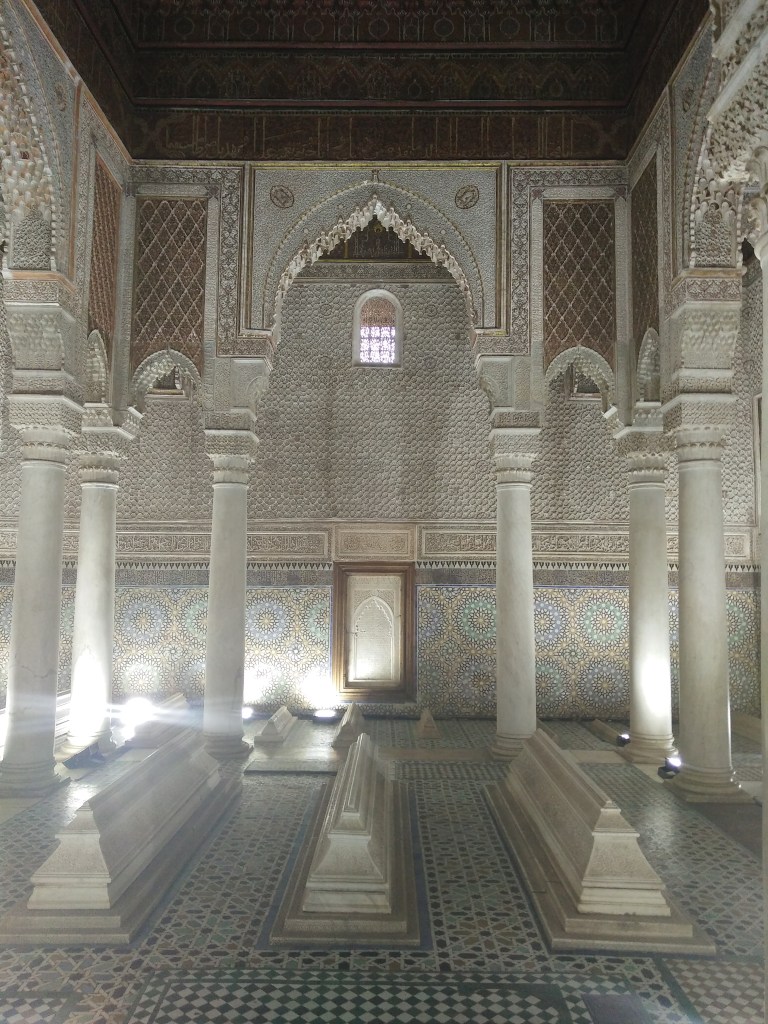
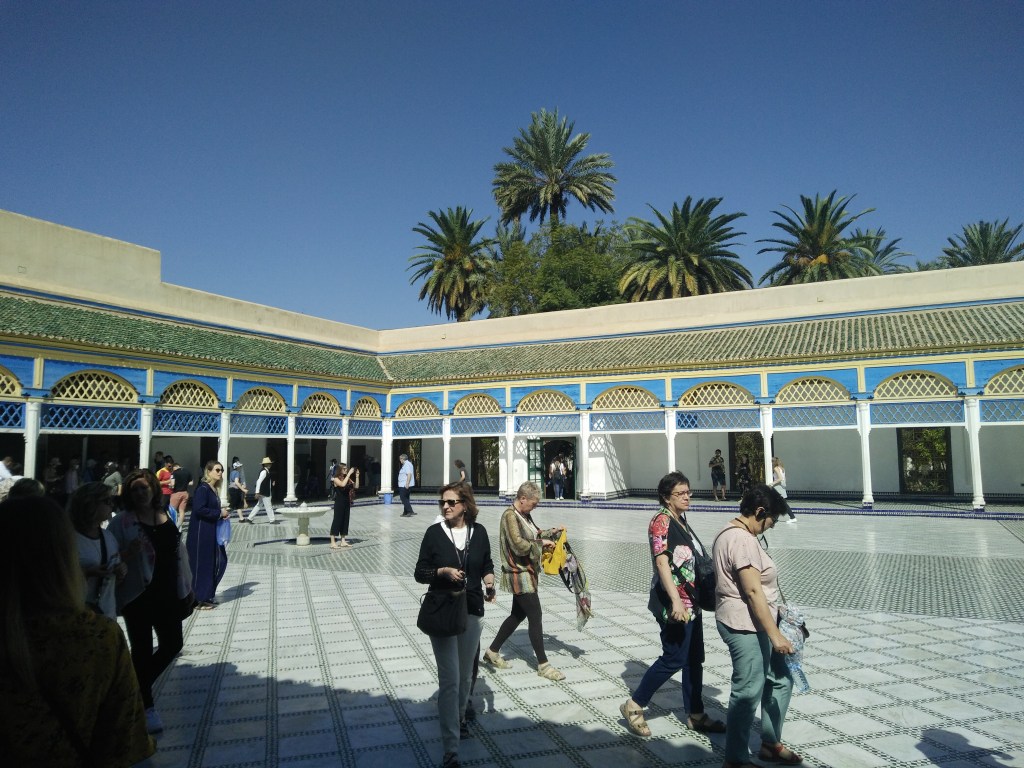
This was our favourite place, and a destination not as well known by tourists. Called the Dar Si Said, it’s in a renovated palace and is a carpet and weaving museum. The architecture in the place was absolutely stunning. Every wall was intricately tiled, and there was beautiful woodwork on the ceilings and door frames. There were also two courtyards within the palace, one with a garden. The exhibitions themselves were also quite interesting, and showed the traditional art of carpet making, and some very impressive examples among other items. All around it was an excellent experience, and one of the cheapest too.


That was it for Marrakech, almost. From Marrakech we also did some trips, first of all to the Atlas Mountains and second to the Sahara desert. But that’s another story for another blog post.
 Anna Fay On Holiday